
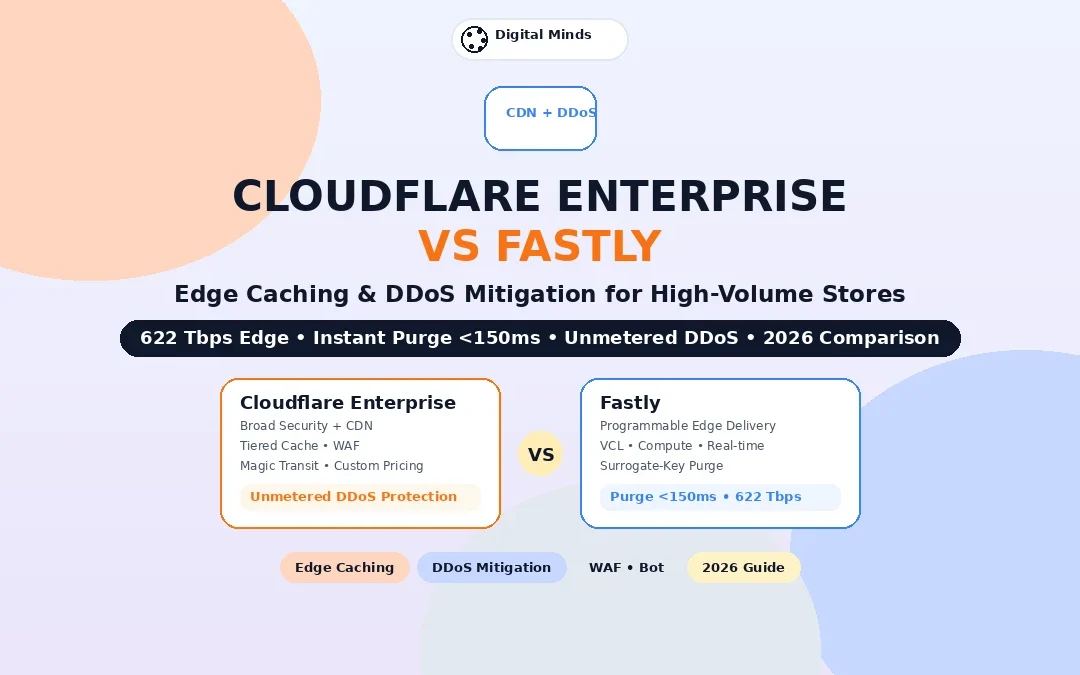
Cloudflare Enterprise vs Fastly: Edge Caching and DDoS Mitigation for High-Volume Stores
When an e-commerce site serves millions of requests, the CDN is no longer just a speed layer. It becomes part of the store's security perimeter, caching strategy, origin architecture, deployment workflow, and infrastructure budget.
Cloudflare Enterprise and Fastly both target demanding digital businesses, but they approach edge delivery differently. This guide compares their caching controls, purge workflows, DDoS protection, pricing models, developer control, origin shielding, observability, and suitability for high-volume stores.
Quick Answer: Cloudflare Enterprise or Fastly?
Cloudflare Enterprise is positioned as a broad enterprise network and application platform, combining CDN, DDoS protection, WAF, DNS, caching, edge services, and other security capabilities under a custom enterprise contract.
Fastly is strongly oriented toward programmable edge delivery, real-time control, high-performance caching, instant purging, observability, and developer-driven traffic logic. Fastly publishes usage-based CDN pricing for its standard tiers, while Enterprise pricing is custom.
For a high-volume store, the most useful question is therefore not simply "Which CDN is faster?" It is: "Which edge architecture gives our team the right combination of cache efficiency, security controls, operational visibility, customization, and predictable economics?"
What Is an Enterprise Edge Platform?
A traditional CDN primarily caches content closer to users. Modern enterprise edge platforms do much more.
They can sit between shoppers and the origin infrastructure and handle:
- Static content caching.
- Dynamic content acceleration.
- TLS termination.
- DDoS detection and mitigation.
- Web application firewall rules.
- Bot and abuse controls.
- Request routing.
- Cache-key manipulation.
- Edge computing.
- Real-time traffic analytics.
- Origin shielding.
- Cache invalidation and deployment controls.
For an online retailer, this matters because the edge can determine whether a request reaches the application at all.
The more requests that can be safely completed at the edge, the fewer requests the origin has to process.
That can improve scalability, reduce origin bandwidth, and give the application more headroom during promotions, product launches, and traffic spikes.
Cloudflare Enterprise: What You Are Buying
Cloudflare's enterprise offering is broader than a traditional CDN contract. Its platform combines traffic delivery and security capabilities, with enterprise plans available under a custom contract.
Cloudflare's current plan documentation lists its Contract tier as custom-priced for mission-critical applications. Cloudflare also lists unmetered DDoS protection and CDN functionality across its plan structure. :contentReference[oaicite:1]{index=1}
Global content delivery
Cloudflare caches content across its distributed network and supports configurable Cache Rules and Tiered Cache.
Network protection
Cloudflare provides managed DDoS protection across network and application layers, with additional enterprise capabilities.
Programmable platform
Enterprise customers can combine delivery, security, routing, and edge-compute capabilities within one platform.
Cloudflare's current documentation also provides multiple Tiered Cache topologies. Enterprise customers can access additional global and custom topologies that are not available on lower tiers. :contentReference[oaicite:2]{index=2}
Fastly: What Makes Its Edge Model Different?
Fastly describes its CDN as a programmable edge platform designed for high-performance content delivery, dynamic content, real-time observability, configurable traffic behavior, and rapid cache control.
Fastly's current product documentation highlights its high-capacity network, programmable control, real-time visibility, Instant Purge, origin shielding, and integrated security capabilities. :contentReference[oaicite:3]{index=3}
Published Instant Purge figure
Fastly currently advertises regional mean purge times below 150 ms for Instant Purge.
Published edge capacity
Fastly currently publishes 622 Tbps of edge network capacity on its product platform.
Traffic visibility
Fastly emphasizes real-time logging, metrics, traffic inspection, and API-driven control.
These are vendor-published platform figures, not an independent benchmark between Cloudflare and Fastly. Actual shopper latency depends on geography, ISP routing, cache status, origin performance, TLS behavior, application logic, and configuration.
Cloudflare Enterprise vs Fastly for Edge Caching
Caching is where the two platforms become particularly interesting for high-volume stores.
Both can cache static resources and more advanced dynamic workloads. The difference is less about whether caching exists and more about how much control your team wants over cache behavior.
Cloudflare Cache
Cloudflare's current documentation describes Cache Rules as a way to control which resources are eligible for caching, how long they are cached, and how cache behavior interacts with other rules.
Cloudflare also supports Tiered Cache. Its current Smart Tiered Cache can use cloud-region
hints such as aws:us-east-1, gcp:europe-west1, Azure, and Oracle
Cloud regions to help select an appropriate upper tier for public-cloud origins.
:contentReference[oaicite:4]{index=4}
This is particularly useful when a retailer's origin sits in a specific AWS region but shoppers are distributed across North America and Europe.
Fastly Cache
Fastly's cache is designed to serve cacheable content directly from the edge and provides detailed controls through its CDN services and edge-compute environment.
Fastly supports cache policy through headers such as Surrogate-Control,
Cache-Control, and Surrogate-Key. This allows developers to
separate browser caching behavior from CDN behavior and to associate cached objects with
groups that can later be purged. :contentReference[oaicite:5]{index=5}
| Capability | Cloudflare Enterprise | Fastly |
|---|---|---|
| Static asset caching | Yes | Yes |
| Dynamic content caching | Supported through configurable cache rules | Strong support with granular edge controls |
| Tiered / shielded caching | Tiered Cache; enterprise topology options | Origin Shielding |
| Custom cache behavior | Cache Rules and enterprise controls | VCL and Compute-based controls |
| Custom cache keys | Supported; advanced enterprise controls available | Supported through CDN/edge configuration |
| Cache tagging | Cache tags available in relevant Cloudflare workflows | Surrogate-Key support |
| Origin traffic reduction | Tiered Cache can reduce origin requests | Edge caching and shielding reduce origin fetches |
Cloudflare's documentation specifically describes Tiered Cache as a way to reduce origin requests and improve bandwidth efficiency. Fastly similarly describes edge caching as a mechanism for reducing requests to backend servers and data-transfer costs. :contentReference[oaicite:6]{index=6}
Cache Purging: Critical for E-Commerce
Imagine a retailer changes the price of a product from $249 to $199.
The cache may contain the old product page, product JSON, promotional banner, or inventory information.
Waiting for TTL expiration may not be acceptable.
This makes cache invalidation one of the most important operational differences to examine.
Fastly Instant Purge
Fastly is particularly well known for its purge workflow. Its documentation supports URL purges, purge-all, and surrogate-key purging.
Surrogate keys allow a retailer to associate multiple cached objects with a product, category, template, campaign, or other logical identifier and invalidate those objects together. Fastly documents surrogate-key purges as taking around 150 ms in its current documentation. :contentReference[oaicite:7]{index=7}
A product update can then invalidate related cached content without forcing a complete site-wide purge.
Cloudflare Cache Purging
Cloudflare provides purge capabilities through its dashboard and API, including URL, prefix, host, tag, and full-cache purge mechanisms depending on configuration.
Cloudflare's current Cache Rules documentation also notes that cache-key design affects how individual objects can be purged. :contentReference[oaicite:8]{index=8}
DDoS Mitigation: Cloudflare Enterprise vs Fastly
High-volume stores have two different security problems:
- Legitimate high traffic that the infrastructure must absorb.
- Malicious traffic designed to consume capacity or disrupt the application.
A good edge platform must help distinguish between the two.
Cloudflare DDoS Protection
Cloudflare's current documentation describes managed DDoS rules covering multiple network and application layers. Enterprise customers can also use additional controls such as Adaptive DDoS Protection in applicable products. :contentReference[oaicite:9]{index=9}
At the network level, Cloudflare Magic Transit extends DDoS protection to IP networks, including cloud-hosted, on-premises, and hybrid environments. Cloudflare describes its mitigation architecture as operating close to the source of attacks through its global network. :contentReference[oaicite:10]{index=10}
Fastly DDoS Protection
Fastly DDoS Protection provides real-time visibility and mitigation for common DDoS attacks directed at applications, APIs, and origin servers. Fastly's documentation says the product operates at the network edge and provides dashboards, events, and configurable rules.
Fastly's current documentation also makes an important operational point: its DDoS product is not a guarantee against every possible attack, and organizations should maintain appropriate security controls on their applications and origins. :contentReference[oaicite:11]{index=11}
| Security area | Cloudflare Enterprise | Fastly |
|---|---|---|
| Application-layer DDoS | Managed DDoS protection | DDoS Protection product |
| Network-layer protection | Available through Cloudflare network/security products | Network-edge DDoS capabilities |
| Enterprise DDoS controls | Advanced enterprise options | Configurable DDoS rules and controls |
| DDoS analytics | Cloudflare security and network analytics | Dashboards, events and attack traffic metrics |
| Origin protection | Edge filtering plus origin security architecture | Edge mitigation plus origin protection controls |
| Enterprise network protection | Magic Transit available | Fastly security/network products vary by deployment |
WAF and Application Security
A DDoS system is only one part of the security stack.
High-volume stores also have to deal with SQL injection attempts, credential abuse, malicious bots, API attacks, scraping, automated checkout abuse, and application-specific vulnerabilities.
Cloudflare and Fastly both offer WAF capabilities, but the commercial packaging and implementation experience differ by plan.
Cloudflare
Cloudflare's platform combines its CDN and security controls closely. Its current plan information lists WAF functionality alongside CDN and DDoS protection. :contentReference[oaicite:12]{index=12}
Fastly
Fastly provides its Next-Gen WAF alongside CDN and DDoS products. Its service creation documentation shows DDoS Protection and Next-Gen WAF as security options within the Fastly platform. :contentReference[oaicite:13]{index=13}
Dynamic E-Commerce Traffic Changes the CDN Equation
Static content is easy to cache.
E-commerce is not.
Consider these URLs:
They do not all deserve the same caching policy.
| Resource | Typical cache approach | Risk to consider |
|---|---|---|
| Product images | Long edge TTL | Stale image after asset replacement |
| CSS / JS | Long TTL with versioned filenames | Old asset after deployment |
| Public product pages | Cache with controlled invalidation | Price/inventory freshness |
| Category pages | Cache with product-aware invalidation | Catalog changes |
| Search results | Selective or short-lived caching | Personalization and query variation |
| Cart | Generally dynamic | Customer-specific state |
| Checkout | Generally dynamic / bypass cache | Security and transactional state |
| Account pages | Generally dynamic / bypass cache | Private customer data |
The CDN that produces the highest cache-hit ratio is not necessarily the right CDN if your cache policy is unsafe or creates stale commercial information.
Origin Shielding: Protecting the Store Behind the CDN
One of the most important concepts for large stores is reducing the number of edge locations that need to contact the origin directly.
Imagine a retailer with shoppers in New York, Los Angeles, London, Frankfurt, Singapore, and Sydney.
Without an effective shielding strategy, cache misses can create a large number of origin fetches.
A tiered or shielded architecture can instead consolidate those origin requests.
Cloudflare's Tiered Cache is specifically designed to reduce origin requests by using upper-tier data centers. Fastly similarly offers Origin Shielding to improve cache efficiency and reduce origin traffic. :contentReference[oaicite:14]{index=14}
This matters especially when the origin is hosted in AWS, Azure, Google Cloud, or another centralized environment.
For example, if your primary AWS origin is in US East (N. Virginia),
Cloudflare's current Smart Tiered Cache documentation allows an AWS region hint such as
aws:us-east-1 so the tiering system can choose an upper tier appropriate
to the cloud origin. :contentReference[oaicite:15]{index=15}
Cloudflare Enterprise vs Fastly Pricing
Pricing is one area where a simple table can be misleading.
Cloudflare's enterprise Contract tier is custom-priced. Fastly publishes usage-based pricing for its standard CDN offering and states that enterprise infrastructure is custom-priced. :contentReference[oaicite:16]{index=16}
Published Fastly CDN Pricing
Fastly currently publishes 100 GB of monthly bandwidth free for Full Site Delivery, followed by region-specific per-GB pricing. Its published North America rate for the 100 GB–10 TB tier is currently $0.12/GB, with the next 10 TB listed at $0.08/GB. Requests are separately billed after the included allowance. :contentReference[oaicite:17]{index=17}
| Pricing area | Cloudflare | Fastly |
|---|---|---|
| Enterprise CDN pricing | Custom contract pricing | Custom enterprise pricing |
| Self-service entry | Free / Pro / Business tiers | Free / Growth usage-based tiers |
| Published CDN bandwidth pricing | Not comparable to a simple enterprise per-GB rate | Yes, regional usage-based pricing published |
| Fastly North America bandwidth, 100 GB–10 TB | — | $0.12/GB |
| Fastly North America next 10 TB | — | $0.08/GB |
| Enterprise support | Contract-based | Enterprise package / contract |
Cloudflare Enterprise vs Fastly: Real-World Capability Comparison
The following comparison uses published provider documentation and separates factual platform capabilities from subjective purchasing decisions.
| Requirement | Cloudflare Enterprise | Fastly |
|---|---|---|
| Enterprise pricing | Custom contract | Custom enterprise pricing |
| CDN | Yes | Yes |
| Tiered caching | Yes; enterprise topology options | Origin Shielding |
| Dynamic content | Supported with configurable rules and edge platform | Strong programmable edge support |
| Cache rules | Cache Rules | VCL / Compute configuration |
| Targeted invalidation | URL, prefix, host, tag and related purge options | URL and surrogate-key purging |
| DDoS | Managed DDoS protection with enterprise options | DDoS Protection product |
| WAF | Cloudflare WAF | Fastly Next-Gen WAF |
| Edge compute | Cloudflare Workers and related edge services | Fastly Compute |
| Real-time logs | Available through Cloudflare analytics/logging products | Strong real-time logging and observability focus |
| API/automation | Extensive API and infrastructure automation | API/CLI-driven workflow |
| Public CDN pricing | Standard plans publicly listed; enterprise custom | Usage-based rates publicly listed; enterprise custom |
| Network security breadth | Broad network/application security platform | CDN, WAF, DDoS and edge security platform |
Architecture Example: High-Volume US + EU Store
Consider a retailer with its main application in AWS US East (N. Virginia), European customers in London and Frankfurt, and significant traffic from both continents.
Cloudflare-style architecture
Fastly-style architecture
These diagrams are conceptual rather than mandatory architectures. Both platforms support significantly more sophisticated deployments.
The key point is that the CDN should absorb as much safe traffic as possible before it reaches the application origin.
How to Calculate the True Cost of a CDN
The cheapest price per GB is not necessarily the lowest total cost.
A serious procurement comparison should calculate:
Then compare that against business outcomes:
- Origin bandwidth reduction.
- Origin CPU reduction.
- Database request reduction.
- Checkout latency.
- Cache-hit ratio.
- Attack mitigation.
- Incident response time.
- Engineering hours spent managing the edge.
- Release and cache-invalidation speed.
- Availability during traffic spikes.
Cache-Hit Ratio Matters More Than the CDN Logo
Suppose a store receives 100 million monthly requests.
If 85 million can be served from cache, only 15 million requests need to travel farther toward the origin.
Total requests
All customer and automated requests reaching the edge.
Illustrative cache hit
Most cacheable content is completed without origin fetches.
Origin opportunities
The remaining requests require further processing or origin interaction.
This example is illustrative, not a benchmark for either provider.
The important metric for your own store is the measured cache-hit ratio by URL category, geography, device, request type, and traffic source.
Cloudflare Enterprise vs Fastly for WordPress and WooCommerce
WordPress and WooCommerce introduce special CDN challenges because the site can contain both highly cacheable public content and highly personalized customer workflows.
Excellent CDN candidates
- Product images.
- Category images.
- CSS files.
- JavaScript files.
- Fonts.
- Product brochures.
- Public PDFs.
- Versioned static assets.
Requests requiring caution
- Cart pages.
- Checkout.
- My Account.
- Customer-specific pricing.
- Logged-in dashboards.
- Payment flows.
- Inventory-sensitive responses.
- Personalized recommendations.
Before changing CDN providers, audit cookies, authorization headers, query strings, WooCommerce fragments, AJAX endpoints, REST APIs, and cache-control headers.
For broader hosting architecture, see our guide to shared vs VPS vs cloud hosting .
For WordPress performance considerations, see our Cloudways vs Hostinger cloud performance comparison and our managed cloud hosting guide for US businesses .
If you're running WooCommerce specifically, our WooCommerce US-East TTFB and checkout-speed comparison provides additional context on origin performance.
Should You Move an Existing Store to a Different CDN?
A CDN migration should not begin with DNS.
It should begin with measurement.
- Record the existing baseline. Capture TTFB, cache-hit ratio, origin requests, bandwidth, error rates, checkout latency, and major traffic regions.
- Export your current cache rules. Document every bypass rule, cookie condition, query-string rule, TTL, and purge process.
- Map security policies. Document WAF rules, rate limits, bot controls, IP restrictions, and DDoS settings.
- Test staging. Validate anonymous pages, logged-in sessions, carts, checkout, APIs, search, and third-party integrations.
- Run a controlled DNS migration. Reduce DNS TTL ahead of the change where appropriate and maintain rollback procedures.
- Monitor the first 24–72 hours. Watch cache misses, origin load, errors, latency, WAF events, and checkout conversion.
If you're planning a high-traffic WordPress infrastructure migration, see our high-traffic WordPress migration guide .
Enterprise CDN Buying Checklist
Before signing a contract, ask both vendors the same questions.
| Category | Question |
|---|---|
| Bandwidth | What is the effective price at our actual monthly traffic volume? |
| Requests | Are request charges included or billed separately? |
| Security | Which WAF, DDoS, bot, and rate-limit capabilities are included? |
| Cache | Can we customize cache keys and cache TTL by URL, cookie, header, and query string? |
| Purge | Can we purge by URL, tag/key, prefix, and API? |
| Origin | What shielding or tiered caching options are available? |
| Observability | Can engineering inspect cache misses, origin fetches, security events, and latency? |
| Support | What response times and escalation paths are included? |
| Contract | Are there minimum commitments, overages, or traffic-band changes? |
| Migration | Will the provider support configuration migration and production cutover? |
7 Common CDN Migration Mistakes High-Volume Stores Make
1. Comparing only price per GB
CDN economics include security, requests, support, logging, origin traffic, and engineering time.
2. Caching everything
Dynamic customer-specific content can become a security and correctness problem when cached incorrectly.
3. Never testing cache invalidation
A CDN can perform beautifully until a merchandising team changes 20,000 products and discovers that invalidation is too slow or too broad.
4. Ignoring origin performance
A CDN cannot completely hide a slow database, overloaded PHP workers, poorly tuned APIs, or inefficient application code.
5. Treating DDoS protection as complete security
DDoS mitigation is one security layer. It does not replace secure coding, authentication, patching, origin hardening, fraud controls, or application monitoring.
6. Migrating during a major promotion
Do not schedule a CDN migration immediately before Black Friday, Cyber Monday, a major product launch, or another predictable traffic event.
7. Failing to lock down the origin
If attackers can bypass the CDN and directly reach the origin IP, much of the edge security architecture becomes less useful.
Cloudflare Enterprise vs Fastly: Which Architecture Fits Your Store?
Rather than choosing by brand preference, map the platform to your operational requirements.
| Your priority | What to investigate | Why it matters |
|---|---|---|
| Broad security platform | Cloudflare Enterprise capabilities | Can consolidate CDN, DDoS, WAF, DNS and other controls. |
| Developer-controlled edge | Fastly VCL / Compute and Cloudflare Workers | Lets engineering customize request and response behavior. |
| Very frequent content changes | Instant purge / targeted purge workflows | Important for inventory, prices and campaigns. |
| Global public content | Tiered cache / origin shield design | Can reduce origin traffic and improve cache efficiency. |
| Predictable enterprise procurement | Contract structure and committed traffic | Headline per-GB rates may not represent negotiated enterprise economics. |
| Real-time troubleshooting | Logging and observability capabilities | Critical during promotions, attacks and performance incidents. |
Related Infrastructure Guides
Managed WordPress
Learn how managed WordPress hosting changes the infrastructure workload for agencies and growing businesses.
HIPAA Hosting
Healthcare websites need a different approach to infrastructure, security, contracts, encryption and auditability.
AWS Egress
Network architecture can significantly influence cloud bills when stores generate large amounts of outbound traffic.
Frequently Asked Questions
Is Cloudflare Enterprise faster than Fastly?
There is no universal answer. Real-world CDN performance depends on the visitor's location, ISP, cache-hit status, origin location, TLS connection, routing, configuration, and application behavior. A meaningful comparison should test the same URLs, regions, cache states, and traffic patterns.
Is Fastly better for e-commerce?
Fastly provides capabilities that are particularly relevant to e-commerce, including programmable edge behavior, granular caching, Origin Shielding, real-time visibility, and targeted purge workflows. Whether those capabilities fit a particular retailer depends on its application architecture and engineering requirements.
Is Cloudflare Enterprise good for high-traffic stores?
Cloudflare Enterprise is designed for mission-critical applications and provides CDN, DDoS protection, WAF and broader network and edge capabilities. Its enterprise plan is custom-priced, so buyers should evaluate the complete contract against their traffic and security requirements.
Does Fastly offer DDoS protection?
Yes. Fastly offers DDoS Protection for applications, APIs and origin servers. Its documentation describes real-time detection, mitigation, dashboards, events and configurable rules.
Does Cloudflare provide DDoS protection?
Yes. Cloudflare provides managed DDoS protection across relevant network and application layers, with additional enterprise and network-security products available for more advanced requirements.
Which CDN has better cache purging?
Both provide cache invalidation capabilities. Fastly is particularly known for Instant Purge and surrogate-key workflows, while Cloudflare supports multiple purge methods including URL, prefix, host and tag-based approaches depending on configuration. The appropriate choice depends on how your store models products, categories, promotions and content dependencies.
Does Fastly have public CDN pricing?
Yes. Fastly publishes usage-based pricing for its Full Site Delivery CDN, including region-specific bandwidth and request rates. Fastly also states that enterprise infrastructure is custom-priced.
Does Cloudflare Enterprise have a public fixed price?
Cloudflare's Contract tier is custom-priced rather than presented as a fixed public monthly enterprise price. The final cost therefore needs to be evaluated from an account-specific quote and contract.
Can a CDN reduce AWS bandwidth costs?
Yes. A CDN can serve cacheable content from its edge rather than repeatedly fetching that content from an AWS origin. The net savings depend on the CDN's pricing, cache hit ratio, origin architecture, and the traffic that can safely be cached.
Should WooCommerce checkout pages be cached?
Checkout and other customer-specific transactional pages generally require careful cache bypass rules because they contain personalized and transactional state. Cache public assets aggressively while treating customer-specific workflows separately.
Does Cloudflare or Fastly replace a web application firewall?
Both providers offer WAF capabilities, but deploying a CDN does not automatically make an application secure. WAF policies, origin hardening, authentication, patching, application security and monitoring remain important.
The Bottom Line for High-Volume Stores
Cloudflare Enterprise and Fastly are both capable enterprise edge platforms, but they should not be evaluated as interchangeable “CDNs” based on a single speed test.
Cloudflare's enterprise model brings together CDN, DDoS, WAF, network security and broader edge capabilities under a custom contract. Fastly places strong emphasis on programmable delivery, granular cache control, rapid invalidation, real-time visibility, and edge development.
For a large retailer, the decision should come down to measurable requirements: cache-hit ratio, origin load, purge behavior, security controls, geographic traffic, engineering workflow, observability, support, and total cost.
The best procurement process is therefore not to ask which vendor has the biggest feature list. Build a representative test using your actual product pages, images, APIs, checkout flows, geographic traffic, cache rules and security policies.
Then compare the results against your current CDN using the same measurements.
Editorial and pricing note: Provider capabilities, pricing, product names and service packaging can change. Published figures in this article are based on provider documentation available in September 2026. Enterprise quotes, negotiated discounts, regional traffic and contract commitments can produce materially different effective costs. Always validate current commercial terms before purchasing.