
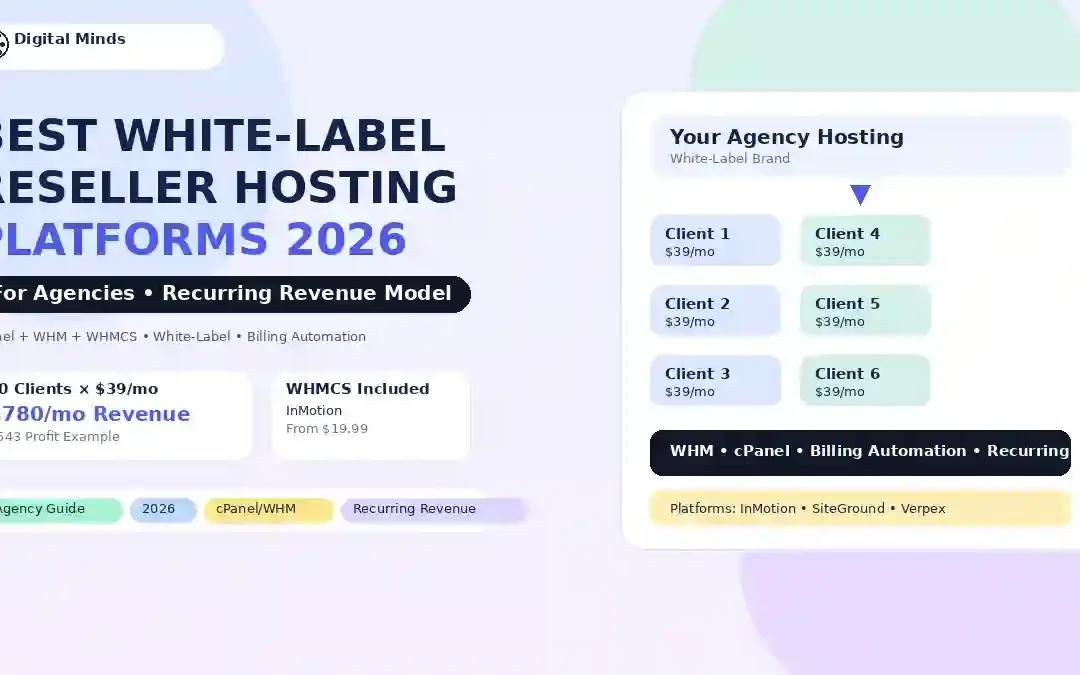
Best White-Label Reseller Hosting Platforms for Digital Marketing Agencies in 2026
White-label hosting can turn an agency's existing client relationships into recurring revenue. But the cheapest reseller plan is not automatically the most profitable one. The real equation includes hosting cost, client account limits, billing automation, support workload, control-panel experience, renewals, and the amount you can realistically charge each client.
Quick Answer: Which White-Label Reseller Hosting Model Fits an Agency?
For agencies that want traditional cPanel + WHM + automated billing, reseller platforms such as InMotion and Verpex are designed around the classic hosting-reseller model. SiteGround takes a different approach, offering white-label agency hosting and custom hosting packages while using its own Site Tools environment rather than traditional cPanel.
The most important decision is therefore not simply "Which host is cheapest?" It is: How much recurring revenue can each client generate after hosting, billing software, support time, payment fees and renewal costs?
Think in Client Economics
A $20 hosting plan can become highly profitable when spread across 20–30 clients, but only if account limits and support workload remain manageable.
Billing Automation Matters
WHMCS-style provisioning can reduce manual account creation, invoicing, renewals, suspension and service-management work.
cPanel Is Not Mandatory
Agencies can consider modern alternatives such as Site Tools or newer white-label hosting control panels when client simplicity matters more than legacy workflows.
What Is White-Label Reseller Hosting?
White-label reseller hosting allows an agency to purchase hosting resources from an infrastructure provider and sell those services to clients under the agency's own brand. The underlying provider operates the infrastructure, while the agency controls the customer-facing relationship.
In a traditional setup, a client might receive an invoice from a large hosting company. With a white-label model, the client can instead receive a hosting plan from Your Agency Hosting, Your Managed WordPress, or whatever service brand your agency creates.
This model works particularly well for agencies already responsible for website design, WordPress maintenance, SEO, PPC landing pages, analytics and ongoing website support. Hosting becomes another recurring service rather than another vendor the client has to manage.
Before choosing a reseller platform, it is useful to understand the difference between shared, VPS and cloud infrastructure. Our guide on shared vs VPS vs cloud hosting explains the underlying models in more detail.
Why Digital Marketing Agencies Are Adding Hosting to Their Services
A digital marketing agency already has one of the hardest assets to acquire: an established client relationship.
Once an agency manages a client's website, SEO campaigns, analytics, conversion tracking or advertising, moving hosting into the same service relationship can simplify operations. Instead of asking the client to contact three different companies for website issues, DNS problems and hosting renewals, the agency can manage the stack from one place.
Recurring Revenue
Hosting can be sold monthly or annually and bundled with maintenance, security, backups and performance monitoring.
Higher Client Stickiness
When hosting, maintenance and website management are combined, the agency becomes a more central part of the client's technology stack.
Fewer Vendors
Agencies can standardize DNS, backups, staging, SSL, monitoring and support instead of managing a different provider for every client.
This is particularly useful for agencies that sell website care plans. Instead of charging only for occasional maintenance, the agency can create packages such as:
- Website Hosting — $25/month
- Managed WordPress — $49/month
- Business Website Care — $99/month
- Performance + Security — $149/month
- WooCommerce Managed Hosting — $199+/month
The exact prices are business decisions, not universal market rates. The important point is to price around value and support responsibility, rather than simply adding a small markup to the underlying server cost.
Best White-Label Reseller Hosting Platforms in 2026
The platforms below represent different approaches. Some follow the traditional WHM/cPanel reseller model, while others focus on agency-oriented managed hosting. That distinction is important because an agency selling hosting does not necessarily need to operate like a traditional hosting company.
| Platform | Published 2026 Pricing* | White Label | cPanel / WHM | Billing Automation | Best Fit |
|---|---|---|---|---|---|
| InMotion Hosting | From $19.99/mo intro | Yes | Yes | WHMCS included | Traditional agency reseller |
| SiteGround | From $4.99/mo entry offer* | Yes | No | Agency workflow | Managed agency hosting |
| Verpex | From $17.90/mo published reseller pricing | Yes | Yes | Third-party / WHM ecosystem | cPanel-focused agencies |
*Prices are published provider prices observed in September 2026 and may depend on billing term, introductory offers, taxes and renewal period. Always verify the checkout price before purchase.
1. InMotion Hosting — Traditional White-Label Agency Reseller Model
InMotion is particularly relevant to agencies that want the classic reseller architecture: WHM for the agency, cPanel for clients and WHMCS for billing/client management. Its published reseller plans include white-label branding, custom nameservers, WHMCS, cPanel accounts and US/EU data-center options.
Its current published entry pricing starts at $19.99/month on the displayed promotional term, with higher renewal pricing. Higher plans increase the number of included cPanel licenses and storage. :contentReference[oaicite:1]{index=1}
View InMotion Hosting's current reseller and WHMCS details .
Why agencies may consider it: It provides a familiar operating model for agencies that want to sell hosting as a clearly defined product rather than simply include hosting inside a website maintenance package.
2. SiteGround — Managed Agency Hosting Without Traditional cPanel
SiteGround takes a noticeably different approach. Its agency reseller environment uses Site Tools rather than traditional cPanel, while offering white-label tools, private DNS, site isolation and custom hosting packages on its Cloud offering.
SiteGround currently lists GrowBig from $4.99/month on a prepaid promotional offer, GoGeek from $7.99/month and Cloud from $100/month, with different features at each level. The published pages also state that Cloud plans can be used to create custom hosting packages and that white-label Site Tools are available. :contentReference[oaicite:2]{index=2}
See SiteGround's current reseller hosting options .
The key difference: SiteGround can make sense when your clients do not need traditional cPanel and your agency prefers a managed hosting experience. It is less suitable if your workflow depends heavily on cPanel/WHM conventions.
3. Verpex — cPanel Reseller Hosting With White-Label Branding
Verpex remains close to the traditional reseller model. Its published reseller plans provide separate cPanel accounts, WHM management, white-label branding, custom nameservers, daily backups and multiple server-location choices.
Its current published plan information lists Reseller 15 with 15 cPanel accounts and 50GB NVMe storage, Reseller 60 with 60 accounts and 180GB, and Reseller 100 with 100 accounts and 300GB. Published renewal pricing is $22/month, $69/month and $90/month respectively on the listed plans. :contentReference[oaicite:3]{index=3}
Check Verpex reseller hosting plans and current specifications .
A useful detail for international agencies is server-location flexibility. Verpex publishes London, New York, Sydney, Singapore and other location options for its reseller infrastructure. :contentReference[oaicite:4]{index=4}
Real-World Reseller Hosting Margin Calculations
This is where reseller hosting becomes a business decision rather than a hosting comparison. Do not calculate profit using only the advertised hosting price.
Your real cost can include:
- Reseller hosting or cloud infrastructure
- WHMCS or another billing platform
- Payment processing
- Backup storage
- Security and malware protection
- Support labour
- Migration time
- Domain registration costs
- Email support
- Monitoring
- Premium plugins or licenses
Example: 20 Client Websites
Imagine an agency has 20 relatively small business websites and charges each client $39/month for managed hosting.
| Item | Example Monthly Amount | Calculation |
|---|---|---|
| Client revenue | $780 | 20 × $39 |
| Hosting infrastructure | $22 | Illustrative reseller cost |
| Billing / software allocation | $30 | Illustrative allocation |
| Backup/security allocation | $40 | Illustrative allocation |
| Payment processing | $25 | Illustrative allowance |
| Support allocation | $120 | Illustrative internal labour cost |
| Illustrative operating contribution | $543 | $780 − $237 |
What Happens at 50 Clients?
Scale changes the economics because many infrastructure costs do not increase linearly with every additional client.
| Client Count | Monthly Price / Client | Revenue | Illustrative Hosting Cost | Revenue per Infrastructure Dollar |
|---|---|---|---|---|
| 10 | $39 | $390 | $22 | 17.7× |
| 20 | $39 | $780 | $22 | 35.5× |
| 50 | $39 | $1,950 | $69 | 28.3× |
| 100 | $39 | $3,900 | $90 | 43.3× |
These figures are deliberately illustrative. They demonstrate an important principle: the reseller business can have attractive infrastructure economics, but only if your operational workload is controlled.
If every $39 hosting client generates two support tickets every month, the support cost can become more important than the server bill.
Automated Client Billing: Why WHMCS Still Matters
A reseller business becomes difficult to scale when every client is handled manually. Imagine creating an account, generating an invoice, sending renewal reminders, activating payment, suspending an overdue service and provisioning hosting by hand.
That workflow may be manageable with five clients. It becomes painful with 50.
What Billing Automation Should Handle
Recurring Invoices
Automatically create monthly or annual invoices based on the client's hosting package.
Provisioning
Connect billing with hosting infrastructure so a paid order can trigger account creation.
Renewals
Automate reminders and recurring charges instead of manually tracking dozens of renewal dates.
Suspension
Overdue services can follow a predefined billing workflow rather than requiring manual intervention.
Support Tickets
Centralized support can keep hosting issues separate from the agency's project-management workflow.
Client Portal
Clients can view invoices, services, tickets and account information without contacting your team for every update.
InMotion explicitly includes WHMCS with its reseller plans, while traditional cPanel reseller providers often integrate with the wider WHM/WHMCS ecosystem. :contentReference[oaicite:5]{index=5}
If your agency is already using a separate accounting platform, CRM or payment system, check whether your hosting automation integrates cleanly before choosing a provider. A cheap server with a poor billing workflow can be more expensive operationally than a higher-priced platform with better automation.
cPanel and WHM Alternatives for Agencies in 2026
cPanel remains familiar, but agencies should not automatically assume that every client needs it.
A modern managed hosting customer may care more about:
- Simple WordPress management
- SSL controls
- Backups and restores
- Staging environments
- PHP version switching
- Performance controls
- Security alerts
- Developer access
- Easy DNS management
SiteGround is an example of an agency-focused platform that uses Site Tools rather than traditional cPanel. Its Cloud offering also includes custom hosting packages and granular client access. :contentReference[oaicite:6]{index=6}
cPanel/WHM vs Modern Agency Panel
| Feature | cPanel + WHM | Modern Agency Panel | Best For |
|---|---|---|---|
| Client familiarity | Very high | Varies | Traditional hosting clients |
| Agency account management | Excellent | Often excellent | Both |
| White-label options | Common | Provider-dependent | Brand-focused agencies |
| WordPress workflow | Good | Often optimized | WordPress agencies |
| Legacy compatibility | Excellent | Variable | Mixed client portfolios |
| Learning curve | Moderate | Provider-dependent | Small teams |
The decision should therefore follow your client portfolio. If you manage PHP applications, WordPress sites, email accounts and traditional hosting clients, cPanel can simplify the transition. If almost every client uses WordPress and your agency manages the technical layer, a managed agency panel may reduce unnecessary complexity.
The Ideal White-Label Hosting Stack for a Digital Agency
A profitable reseller business is not just a server. Think of it as a complete service stack.
| Layer | Purpose | Agency Requirement |
|---|---|---|
| Infrastructure | Runs websites | Reliable CPU, RAM and storage |
| Control Panel | Manages sites/accounts | cPanel/WHM or agency alternative |
| Billing | Recurring revenue | Automated invoices and payments |
| DNS | Domain routing | Reliable DNS and easy record management |
| CDN/WAF | Security and delivery | Traffic filtering and caching |
| Backups | Disaster recovery | Automated off-site backups |
| Monitoring | Availability | Uptime and performance alerts |
| Support | Client experience | Defined SLA and ticket workflow |
For agencies targeting clients in the US and UK, server geography can also matter. A US-focused portfolio may benefit from infrastructure close to major US audiences, while UK-heavy portfolios may benefit from London-area infrastructure. Agencies serving European customers can also consider locations such as Frankfurt.
Performance should be measured from the actual audience location rather than assumed from a provider's marketing page. Our Cloudways vs Hostinger Cloud speed and TTFB comparison provides a useful example of why real-world testing matters.
For US small-business clients, our guide to managed cloud hosting for US small businesses also explains why infrastructure and management level should be considered together.
How to Choose the Right Reseller Hosting Plan
Do not buy based on the number of websites alone. Start with your expected client mix.
Count Real Client Accounts
Separate websites, staging environments and development accounts from your headline client count. If a provider offers 15 or 30 cPanel accounts, determine exactly what consumes an account before committing.
Calculate Your Renewal Cost
Introductory pricing can make a reseller plan appear dramatically cheaper than its long-term cost. Build your margin model around renewal pricing, not only the first invoice.
Price Your Support Time
Hosting support is still labour. Password requests, DNS changes, email problems, plugin conflicts and malware incidents consume agency hours.
Decide Whether You Need cPanel
If clients require traditional hosting controls, cPanel may be useful. If your agency handles the technical layer, a simpler managed panel may create a cleaner client experience.
Check Billing Automation Before Buying
Verify whether the platform integrates with your preferred billing system, payment gateway, provisioning workflow and support process.
Test a Real Client Website
Do not evaluate a reseller platform only with an empty WordPress installation. Test a real site with caching, forms, backups, email, analytics and your normal plugin stack.
What Real-World Agency Hosting Costs Actually Look Like
Published reseller prices provide a useful baseline, but they do not tell the whole story. Consider how different providers structure capacity.
| Provider | Published Plan Detail | Account Capacity | Storage | Renewal / Pricing Note |
|---|---|---|---|---|
| InMotion | R-1000N | 25 cPanel licenses | 80GB SSD | Starts $19.99/mo; renewal listed at $35.99/mo |
| InMotion | R-3000N | 80 cPanel licenses | 200GB NVMe | Starts $39.99/mo; renewal listed at $75.99/mo |
| Verpex | Reseller 15 | 15 cPanel accounts | 50GB NVMe | $22/mo published renewal |
| Verpex | Reseller 60 | 60 cPanel accounts | 180GB NVMe | $69/mo published renewal |
| Verpex | Reseller 100 | 100 cPanel accounts | 300GB NVMe | $90/mo published renewal |
| SiteGround | Cloud | Unlimited websites | 40GB–1TB depending on configuration | From $100/mo; custom packages |
The published figures show why agencies should not compare plans using price alone. A $20 plan with 15 accounts and a $70 plan with 60 accounts have very different economics at scale. :contentReference[oaicite:7]{index=7}
A provider-published 2026 Verpex case study describes a web studio managing 28 client sites under a reseller setup. This illustrates the kind of client density agencies can reach before moving into a larger package, although it should be treated as a provider-published case study rather than an independent benchmark. :contentReference[oaicite:8]{index=8}
White-Label Hosting for WordPress Agencies
WordPress agencies should evaluate reseller hosting differently from general-purpose web hosts. WordPress performance depends on PHP workers, database performance, object caching, page caching, CDN configuration and plugin quality.
If most of your clients are WordPress sites, look for:
- Reliable PHP version management
- Object caching such as Redis where appropriate
- Automatic WordPress updates or controlled update workflows
- Malware scanning
- Automated backups
- One-click staging where available
- Server-level caching
- Easy SSL management
- Resource isolation between client accounts
For agencies managing WooCommerce, resource isolation becomes even more important. A checkout-heavy store should not compete for CPU and database resources with 20 small brochure websites on the same environment.
See our detailed Kinsta vs Cloudways WooCommerce performance comparison for an example of how WordPress commerce hosting should be evaluated using real performance metrics rather than generic hosting specifications.
What If Your Agency Is Moving Existing Clients to a Reseller Platform?
Migration is one of the biggest operational costs that is easy to overlook. A reseller plan can look extremely profitable until your team spends hours moving 40 websites, rebuilding DNS records, testing email and troubleshooting plugin conflicts.
For high-traffic WordPress websites, migration planning should include DNS, database synchronization, cache warming, SSL certificates, cron jobs, transactional email, payment webhooks and rollback procedures.
Our guide on migrating a high-traffic WordPress site to DigitalOcean covers the infrastructure side of this problem, including database synchronization and DNS cutover planning.
7 Common White-Label Reseller Hosting Mistakes
1. Choosing the Lowest Monthly Price
A low promotional price is not necessarily a low total cost. Renewal pricing, software, support and migration labour can change the economics.
2. Ignoring Account Limits
"Unlimited websites" does not necessarily mean unlimited practical capacity. CPU, RAM, storage, inode counts and per-account limits still matter.
3. Forgetting Billing Automation
Manual invoicing becomes a hidden operational tax as your client count grows.
4. Selling Hosting Without Defining Support
If your hosting package includes unlimited support, clients may reasonably treat your agency as their general IT help desk. Define what hosting support includes.
5. Putting Every Client on the Same Resource Tier
A five-page local business website and a busy WooCommerce store should not necessarily receive identical hosting resources.
6. Treating Backups as an Afterthought
A backup that cannot be restored quickly is not a complete disaster-recovery strategy. Test restores periodically.
7. Making the Agency Brand Too Dependent on the Provider
White-labeling should cover the client-facing experience where promised: nameservers, support communication, branding, invoices and documentation.
Example White-Label Hosting Packages an Agency Could Sell
Instead of selling "50GB hosting," package hosting around outcomes that clients understand.
| Package | Example Price | Suitable For | Potential Inclusions |
|---|---|---|---|
| Essential | $29/mo | Small brochure sites | Hosting, SSL, backups, basic monitoring |
| Business | $59/mo | Growing businesses | Managed WordPress, caching, security, priority support |
| Performance | $99/mo | Lead-generation sites | Performance tuning, CDN, monitoring, proactive maintenance |
| Commerce | $199+/mo | WooCommerce | Higher resources, staging, backups, monitoring and priority support |
These are example package structures, not recommended universal market prices. The correct price depends on your agency's costs, target market, SLA and level of management.
The major advantage of packaging is psychological as well as financial: clients buy a managed business service, rather than comparing your infrastructure cost against a $5 consumer hosting plan.
Agencies interested in a more comprehensive managed WordPress model can also review our guide to managed WordPress hosting for agencies .
How to Know If Reseller Hosting Is Actually Profitable
Track these five numbers every month:
- MRR from hosting: total recurring hosting revenue.
- Infrastructure cost: servers, reseller plan and backups.
- Software cost: billing, monitoring, security and premium tools.
- Support hours: time spent on hosting-related requests.
- Churn: how many clients cancel or stop renewing.
The most important number is not the hosting markup. It is the contribution left after the agency has actually delivered the service.
Which Reseller Model Makes Sense for Your Agency?
| If Your Agency Needs... | Look For... |
|---|---|
| Traditional hosting resale | WHM + cPanel + automated billing |
| Maximum client branding | Custom nameservers, white-label panels and branded billing |
| Simple WordPress management | Managed WordPress tools and agency dashboards |
| Many small websites | High account density and resource isolation |
| WooCommerce clients | Strong CPU, RAM, database and caching options |
| International clients | Multiple server regions and CDN support |
| Low admin workload | Automated billing, provisioning and support workflows |
| High agency margins | Predictable renewal pricing and low support overhead |
There is no single reseller architecture that fits every agency. A five-person WordPress studio with 15 clients can have completely different requirements from a marketing agency managing 150 websites.
Frequently Asked Questions About White-Label Reseller Hosting
What is white-label reseller hosting?
White-label reseller hosting lets an agency sell hosting under its own brand while the infrastructure provider operates the underlying hosting environment. The agency typically controls pricing, packaging and the customer relationship.
Is reseller hosting profitable for digital marketing agencies?
It can be profitable when the agency has enough clients to spread infrastructure and software costs while keeping support labour under control. Profit should be calculated after hosting, billing, payment, backup, security and support costs.
Do agencies still need cPanel in 2026?
Not necessarily. cPanel remains useful for traditional hosting workflows, but managed agency platforms can provide simpler WordPress-focused management without cPanel. The right choice depends on client expectations and your technical workflow.
What is WHM used for in reseller hosting?
WHM, or Web Host Manager, is commonly used by resellers to create and manage individual hosting accounts, define resource packages, manage DNS and control server-level hosting functions.
What is WHMCS used for?
WHMCS is commonly used to automate client billing, invoices, service provisioning, renewals, support tickets and other hosting-business workflows.
How much should an agency charge for hosting?
There is no universal price. Agencies should calculate infrastructure, software, payment processing and labour costs, then price according to the level of hosting, security, maintenance and support being provided.
Can I sell WordPress hosting under my agency brand?
Yes. White-label reseller programs are designed for this type of business model. Check whether the provider supports branded nameservers, client-facing branding, account isolation and the billing workflow your agency needs.
Should an agency choose reseller hosting or a VPS?
Reseller hosting generally reduces infrastructure administration and is easier to start with. A VPS can provide more control and customization but also creates more responsibility for server security, updates, backups and monitoring.
Final Verdict: Build the Hosting Business Around Your Agency, Not the Server
White-label reseller hosting can be a powerful recurring-revenue product for digital marketing agencies in 2026, but the winning business model is not necessarily the one with the cheapest server.
The better question is whether the platform lets your agency deliver a reliable, branded service with predictable costs and minimal manual administration.
For a traditional cPanel reseller operation, WHM, cPanel and automated billing remain valuable. For WordPress-focused agencies, a managed platform with a modern client dashboard can remove unnecessary technical complexity. And for larger agencies, infrastructure economics, account isolation and automation become increasingly important.
Start with a small group of existing clients. Measure support time, performance, resource consumption and renewal behaviour. Then build your hosting packages around those real numbers.
That is how an agency turns hosting from another monthly expense into a predictable recurring service line.
Ready to Build a White-Label Hosting Offer?
Start with your client count, calculate your real monthly delivery cost, choose the right control-panel model, and automate billing before scaling.
White Label WHM / cPanel WHMCS WordPress Recurring Revenue